What is Form 4 LLP: A Complete Guide

Feb 17, 2026
Private Limited Company vs. Limited Liability Partnerships

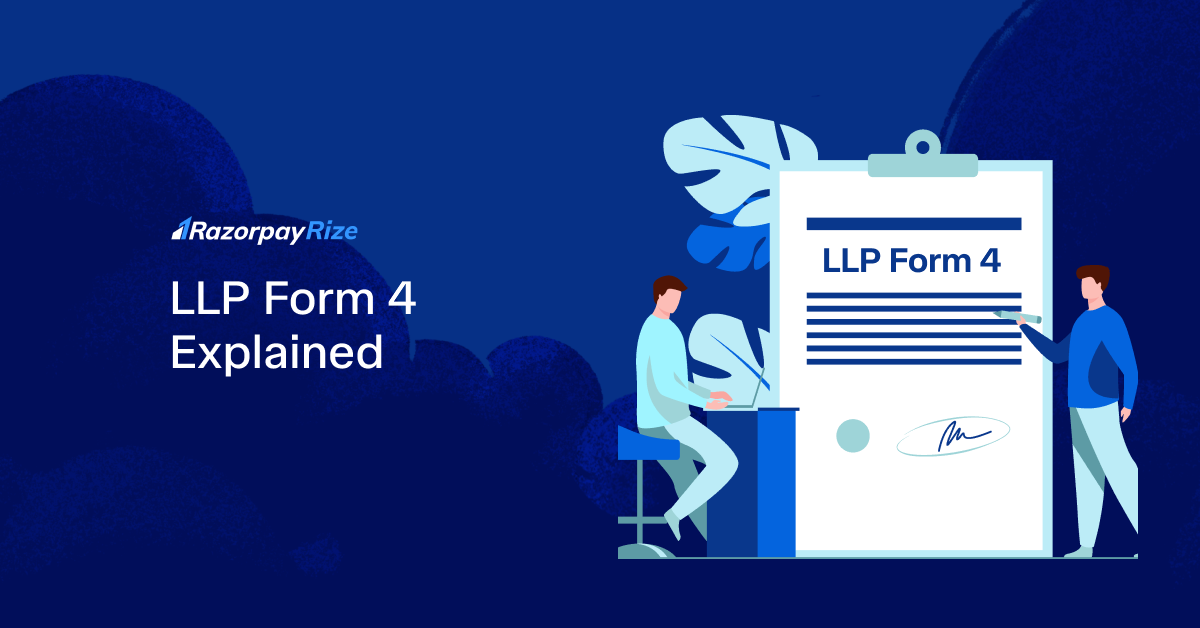
LLP Form 4 is a statutory filing used to inform the government about changes in partners or designated partners of a Limited Liability Partnership (LLP). Whenever a partner joins, exits, or their personal details change, the LLP must report this to the Registrar through the Ministry of Corporate Affairs (MCA).

Filing Form 4 correctly and on time ensures that the LLP remains legally compliant and its public records accurately reflect its current ownership and management.

Table of Contents

Key Takeaways

  • LLP Form 4 is used to report changes related to partners or designated partners in an LLP.
  • It is typically filed when a partner joins, resigns, or when partner details change (name, address, designation, etc.).
  • Form 4 is generally required to be filed within 30 days of the change or event.
  • Correct attachments (proofs, consent/resignation letters, resolutions) reduce chances of resubmission.
  • In many partner change cases, Form 4 is linked with Form 3 (LLP Agreement update).
  • Late filing can lead to additional fees and compliance issues.

What is LLP Form 4

LLP Form 4 is the official MCA form used to update government records whenever there is a change in partner-related information in an LLP.

Form 4 meaning

In simple terms, Form 4 is an intimation to the ROC about who the partners are in an LLP and whether any of their details have changed.

What information is captured in Form 4

  • Name and DPIN/PAN of partner or designated partner
  • Date of appointment, resignation, or change
  • Nature of change (joining, cessation, detail update)
  • Designation (partner or designated partner)
  • Supporting documents related to the change

Related Read: Designated Partner in LLP: Role, Responsibilities, and Legal Requirements

Why is LLP Form 4 filed?

Legal purpose

  • Keeps LLP records updated and legally valid
  • Ensures compliance with the LLP Act, 2008
  • Creates a traceable government record of partner changes

Practical business reasons

  • Avoids compliance flags during audits or due diligence
  • Required by banks, investors, and regulators
  • Maintains transparency in ownership and management
  • Prevents disputes over partner status and authority

When is LLP Form 4 required?

Form 4 is required only when specific partner-related events occur.

Events that trigger Form 4 filing

  • Admission of a new partner
  • Resignation or cessation of a partner
  • Change in partner/designated partner particulars
    (name, address, designation, etc.)
  • Change in contribution-related details
    (only where applicable and properly supported)

Who is responsible for filing Form 4

  • The LLP itself, through an authorised or designated partner
  • The DSC of the authorised signatory is mandatorily used

LLP Form 4 due date and timeline

Standard due date rule

Form 4 should generally be filed within 30 days from the effective date of the change.
Filing early is always advisable to avoid fees, errors, and last-minute document gaps.

What happens if you miss the due date

  • Additional government fees apply
  • LLP compliance status may be impacted
  • Delayed filing with incomplete documents often leads to resubmissions and queries

Documents and attachments required for LLP Form 4

For partner appointment (joining)

  • Consent to act as partner / designated partner
  • Identity proof and address proof (as applicable)
  • Resolution or authorisation (where required)
  • Supporting proof for contribution or designation change

For partner resignation/cessation

  • Resignation letter or cessation proof
  • Acknowledgement or acceptance by LLP (if applicable)
  • Supporting documents as per the LLP Agreement

For a change in partner details (name/address/designation)

  • Proof of change (name change certificate, address proof, etc.)
  • Identity proof (as applicable)
  • Any additional supporting attachments

Optional but helpful attachments

  • Explanation note (for complex changes)
  • Internal approvals or clarifications, if relevant
Did You Know?
Many LLP partner changes require updating both the MCA records and the LLP Agreement, which is why Form 4 is often filed along with Form 3.

Filing Form 4 without updating Form 3 (where required) can cause compliance gaps.
Most resubmissions happen due to weak or unclear attachments. The effective date of change, not the filing date, matters most for timelines.

Step-by-step process to file LLP Form 4 on the MCA portal

Before you start

  • Keep DSC ready
  • Keep partner change proofs and KYC documents ready
  • Confirm the effective date and type of change
  • Check if Form 3 is also required

Filing steps (portal flow)

  1. Log in to the MCA portal
  2. Select LLP Form 4 and enter LLPIN and basic details
  3. Choose the change type and enter partner/designated partner details
  4. Attach required documents
  5. Validate the form and sign using DSC
  6. Submit the form and pay fees
  7. Save the SRN and acknowledgement for tracking

After filing

  • Track SRN status on the MCA portal
  • Keep the filed form and the challan for records
  • Update internal registers and file Form 3 (if applicable)

LLP Form 4 vs LLP Form 3 (quick comparison)

What Form 4 does

  • Updates partner-related changes with the ROC

What Form 3 does

  • Updates or modifies the LLP Agreement

When both are needed

  • When a partner changes, it also requires an amendment of the LLP Agreement
    (e.g., contribution, profit-sharing ratio, rights and duties)

Related Read: LLP Form 3: A Complete Guide

Fees and penalties for late filing of LLP Form 4

What affects the fee

  • Delay in number of days
  • Nature of change being reported

Consequences of delay

  • Additional fees increase with delay
  • Higher compliance risk
  • Potential complications during inspections or due diligence

Common mistakes and how to avoid them

  • Wrong effective date of change
  • Missing consent or resignation proof
  • Unclear KYC documents or mismatched details
  • Not filing Form 3 when the LLP Agreement also changes
  • DSC issues or use of an unauthorised signatory

Razorpay Rize for Company Registration 

Razorpay Rize is your trusted partner in simplifying and redefining the company registration journey. You can seamlessly register your company at the lowest rates, anytime and anywhere.

What is included in our package?

  1. Company Name Registration
  2. 2 Digital Signature Certificates
  3. 2 Directors’ Identification Numbers
  4. Certificate of Incorporation
  5. MoA & AoA (Applicable for Private Limited Companies and OPCs)
  6. LLP Agreement (Applicable for LLPs)
  7. Company PAN & TAN

*May include additional documents depending on the type.

Conclusion

LLP Form 4 is a critical compliance requirement for reporting partner-related changes in an LLP. Accurate details, correct attachments, and timely filing ensure clean MCA records and prevent avoidable penalties. 

When a partner changes, it also affects the LLP Agreement. Filing Form 4 along with Form 3 keeps your LLP fully compliant and future-ready.

Want a simple and secure way to complete online company registration? 100% online company registration - no paperwork, no office visits.
Get started with Razorpay Rize!

Frequently Asked Questions (FAQs)

rize image

Register your Business at just 1,499 + Govt. Fee

Register your business
rize image

Register your Private Limited Company in just 1,499 + Govt. Fee

Register your business
rize image

Register your One Person Company in just 1,499 + Govt. Fee

Register your business
rize image

Register your Business starting at just 1,499 + Govt. Fee

Register your business
rize image

Register your Limited Liability Partnership in just 1,499 + Govt. Fee

Register your business

Private Limited Company
(Pvt. Ltd.)

1,499 + Govt. Fee
BEST SUITED FOR
  • Service-based businesses
  • Businesses looking to issue shares
  • Businesses seeking investment through equity-based funding


Limited Liability Partnership
(LLP)

1,499 + Govt. Fee
BEST SUITED FOR
  • Professional services 
  • Firms seeking any capital contribution from Partners
  • Firms sharing resources with limited liability 

One Person Company
(OPC)

1,499 + Govt. Fee
BEST SUITED FOR
  • Freelancers, Small-scale businesses
  • Businesses looking for minimal compliance
  • Businesses looking for single-ownership

Private Limited Company
(Pvt. Ltd.)

1,499 + Govt. Fee
BEST SUITED FOR
  • Service-based businesses
  • Businesses looking to issue shares
  • Businesses seeking investment through equity-based funding


One Person Company
(OPC)

1,499 + Govt. Fee
BEST SUITED FOR
  • Freelancers, Small-scale businesses
  • Businesses looking for minimal compliance
  • Businesses looking for single-ownership

Private Limited Company
(Pvt. Ltd.)

1,499 + Govt. Fee
BEST SUITED FOR
  • Service-based businesses
  • Businesses looking to issue shares
  • Businesses seeking investment through equity-based funding


Limited Liability Partnership
(LLP)

1,499 + Govt. Fee
BEST SUITED FOR
  • Professional services 
  • Firms seeking any capital contribution from Partners
  • Firms sharing resources with limited liability 

Frequently Asked Questions

What is LLP Form 4 used for?

LLP Form 4 is used to inform the Registrar of Companies (ROC) about any change in partners or designated partners of a Limited Liability Partnership. It captures events such as appointments, resignations, cessations, or changes in partner particulars (name, address, designation, etc.) and updates the official records maintained by the Ministry of Corporate Affairs (MCA).

When should LLP Form 4 be filed after a partner change?

LLP Form 4 should generally be filed within 30 days from the effective date of the partner change (not the filing date).Filing within this timeline helps avoid additional fees and reduces the risk of resubmission due to delayed or incomplete documentation.

What documents are required to file LLP Form 4?

The documents depend on the type of change:

  • For partner appointment

    • Consent to act as partner/designated partner
    • Identity and address proof (as applicable)
    • Resolution or authorisation, if required

  • For partner resignation/cessation

    • Resignation letter or cessation proof
    • Acknowledgement or acceptance by LLP (if applicable)

  • For a change in partner details

    • Proof of change (name change certificate, address proof, etc.)
    • Identity proof, as applicable

Is LLP Form 3 mandatory along with Form 4?

Not always. LLP Form 3 is required only if the LLP Agreement changes due to a partner-related event.

  • If the contribution, profit-sharing ratio, or partner rights change → Form 3 is mandatory
  • If only personal details of a partner change → Form 3 may not be required

In many partner admission or exit cases, Form 4 and Form 3 are filed together to keep records consistent.

Who can sign and submit LLP Form 4?

LLP Form 4 must be signed and submitted by:

  • An authorised or designated partner of the LLP
  • Using a valid Digital Signature Certificate (DSC)

The LLP is responsible for the accuracy of details, even if the filing is done through a professional.

What happens if LLP Form 4 is filed late?

If LLP Form 4 is filed after the due date:

  • Additional government fees are levied based on the delay
  • LLP compliance status may be affected
  • Delayed filing increases the chance of queries or resubmission
  • It may create issues during audits, due diligence, or regulatory checks

Mukesh Goyal

Mukesh Goyal is a startup enthusiast and problem-solver, currently leading the Rize Company Registration Charter at Razorpay, where he’s helping simplify the way early-stage founders start and scale their businesses. With a deep understanding of the regulatory and operational hurdles that startups face, Mukesh is at the forefront of building founder-first experiences within India’s growing startup ecosystem.

An alumnus of FMS Delhi, Mukesh cracked CAT 2016 with a perfect 100 percentile- a milestone that opened new doors and laid the foundation for a career rooted in impact, scale, and community.

Read More

Related Posts

Difference Between Trust, Society & Section 8 Company: Which One to Choose?

Difference Between Trust, Society & Section 8 Company: Which One to Choose?

When you're starting a non-profit organisation in India, one of the first and most important decisions you'll make is how to structure it. Should you register a Trust, a Society, or a Section 8 Company?

Each of these legal forms has its own advantages, legal requirements, and use cases. Choosing the right one depends on your objectives, the nature of your activities, the scale, and how you want to govern the organisation. 

In this guide, we’ll explain the key differences and help you decide which structure best suits your non-profit mission.

Table of Contents

What is a Society?

A society is a non-profit organisation formed by a group of individuals who come together for charitable, literary, scientific, cultural, or educational purposes. Societies in India are governed by the Societies Registration Act, 1860, although many states have their own versions of the Act (e.g., Maharashtra, Tamil Nadu, etc.).

A society must have:

  • A minimum of seven members to register at the state level
  • An elected governing body or managing committee
  • A constitution or memorandum outlining its objectives and rules

Societies are known for their democratic structure, where members have voting rights and leadership is elected periodically.

When to Consider Forming a Society?

Forming a society may be your best option if:

  • You prefer a democratically run organisation with an elected management committee
  • Members may change frequently or seek easy exit options
  • You want a relatively simple dissolution process
  • You're operating within a state jurisdiction (or planning to expand nationally with additional registrations)

Societies are particularly suited for community-driven or volunteer-based initiatives, like resident welfare associations, cultural organisations, and grassroots education or health programs.

Meaning of Trusts

A trust is a legal arrangement under the Indian Trusts Act, 1882 (or relevant state-specific Public Trusts Acts) in which a settlor (or author) transfers property or assets to one or more trustees, who hold and manage them for the benefit of specific beneficiaries.

Key roles in a trust:

  • Author of the trust: The person who creates the trust and donates property
  • Trustee: The person(s) responsible for managing the trust and fulfilling its objectives
  • Beneficiary: The individual(s) or group for whom the trust is created

The central concept is the "beneficial interest"- the trustee has legal control of the asset, but the benefit goes to the beneficiaries. Trusts are often used in both private and public charitable contexts.

Want to register your organisation? Get expert help with Company registration — start your journey today with Razorpay Rize.

When and Why You Might Need a Trust?

You might choose a trust if:

  • You want to retain long-term control without democratic elections or rotating leadership
  • Your non-profit involves family members or a small, stable group of trustees
  • You need privacy, minimal external regulation, or flexible distribution of benefits
  • You plan to manage property, assets, or legacy donations

Trusts are ideal for schools, hospitals, orphanages, and religious institutions, especially when the focus is on asset management and continuity over generations.

Meaning of Section 8 Companies

A Section 8 Company is a special form of non-profit company registered under the Companies Act, 2013. It is incorporated to promote commerce, art, science, research, education, social welfare, religion, or charity.

Key features:

  • It must apply for a license from the Central Government
  • Its profits or income cannot be distributed as dividends
  • All income must be used to promote the organisation’s objectives
  • The name does not include “Limited” or “Private Limited”

Section 8 Companies are highly structured, professionally governed, and seen as credible entities both by donors and government bodies.

Reasons for Forming a Section 8 Company

You should consider registering for Section 8 Company if:

  • You're looking for a formal and transparent governance model
  • You want to build long-term partnerships with government bodies, corporates, or international NGOs
  • You're applying for CSR funds, grants, or FCRA registration
  • You want to project credibility and professionalism in your operations

Section 8 Companies are ideal for large-scale non-profits, social enterprises, or organisations planning to operate across India or internationally.

Difference Between Society, Trust, and Section 8 Company

All three structures, Trusts, Societies, and Section 8 Companies, are eligible for tax exemptions under Section 12A and 80G of the Income Tax Act. They also meet the definition of "charitable purpose" under Section 2(15).

But beyond this, they vary significantly in formation, governance, compliance, and scalability. Here’s a comparison at a glance:

Feature Trust Society Section 8 Company
Governing Law Indian Trusts Act, 1882 or State Trusts Acts Societies Registration Act, 1860 Companies Act, 2013
Minimum members 2 Trustees 7 Members 2 Directors
Legal Status Not a separate legal entity Not a separate legal entity A separate legal entity
Management Trustees (no elections) Governing Body (elected) Board of Directors
Jurisdiction State-level State or national (dual registration needed) Nationwide
Compliance requirements Low Moderate High
Ease of Formation Easy Moderate Requires licensing
Ideal for Asset holding, religious charities, long-term control Community organisations, associations Large-scale NGOs, CSR projects, international collaborations

Each structure, Trust, Society, or Section 8 Company, has its own strengths. The right choice depends on your mission, governance preferences, funding goals, and long-term vision.

Frequently Asked Questions

rize image

Register your Business at just 1,499 + Govt. Fee

Register your business
rize image

Register your Private Limited Company in just 1,499 + Govt. Fee

Register your business
rize image

Register your One Person Company in just 1,499 + Govt. Fee

Register your business
rize image

Register your Business starting at just 1,499 + Govt. Fee

Register your business
rize image

Register your Limited Liability Partnership in just 1,499 + Govt. Fee

Register your business

Private Limited Company
(Pvt. Ltd.)

1,499 + Govt. Fee
BEST SUITED FOR
  • Service-based businesses
  • Businesses looking to issue shares
  • Businesses seeking investment through equity-based funding


Limited Liability Partnership
(LLP)

1,499 + Govt. Fee
BEST SUITED FOR
  • Professional services 
  • Firms seeking any capital contribution from Partners
  • Firms sharing resources with limited liability 

One Person Company
(OPC)

1,499 + Govt. Fee
BEST SUITED FOR
  • Freelancers, Small-scale businesses
  • Businesses looking for minimal compliance
  • Businesses looking for single-ownership

Private Limited Company
(Pvt. Ltd.)

1,499 + Govt. Fee
BEST SUITED FOR
  • Service-based businesses
  • Businesses looking to issue shares
  • Businesses seeking investment through equity-based funding


One Person Company
(OPC)

1,499 + Govt. Fee
BEST SUITED FOR
  • Freelancers, Small-scale businesses
  • Businesses looking for minimal compliance
  • Businesses looking for single-ownership

Private Limited Company
(Pvt. Ltd.)

1,499 + Govt. Fee
BEST SUITED FOR
  • Service-based businesses
  • Businesses looking to issue shares
  • Businesses seeking investment through equity-based funding


Limited Liability Partnership
(LLP)

1,499 + Govt. Fee
BEST SUITED FOR
  • Professional services 
  • Firms seeking any capital contribution from Partners
  • Firms sharing resources with limited liability 

Frequently Asked Questions

Which one should you choose: a Society, a Trust, or a Section 8 Company?

Choose a Trust for simplicity and long-term control, a Society for community-driven work with flexible membership, and a Section 8 Company for structured governance, high credibility, and large-scale funding opportunities.

Can a Section 8 Company be a Trust?

No, a Section 8 Company cannot be a Trust, and vice versa—they are legally distinct entities governed by different acts:

  • A Trust is formed under the Indian Trusts Act, 1882 (or the relevant state act).
  • A Section 8 Company is registered under the Companies Act, 2013.

Is a Trust better than a Company?

A Trust is better for small, asset-focused initiatives that don’t require external validation or heavy fundraising.

A Section 8 Company is better if you want visibility, growth, funding, and governance discipline.

Akash Goel

Akash Goel is an experienced Company Secretary specializing in startup compliance and advisory across India. He has worked with numerous early and growth-stage startups, supporting them through critical funding rounds involving top VCs like Matrix Partners, India Quotient, Shunwei, KStart, VH Capital, SAIF Partners, and Pravega Ventures.

His expertise spans Secretarial compliance, IPR, FEMA, valuation, and due diligence, helping founders understand how startups operate and the complexities of legal regulations.

Read more
How to Convert a Proprietorship into a Private Limited Company in India

How to Convert a Proprietorship into a Private Limited Company in India

Starting as a sole proprietorship is common among freelancers, consultants, and early-stage entrepreneurs. It’s simple, cost-effective, and easy to manage. But as a business grows, so do the legal, financial, and operational complexities — and that’s when many founders consider converting their proprietorship into a Private Limited Company (Pvt Ltd).

In this blog, we break down everything you need to know about this transition — from legal formalities and document requirements to step-by-step procedures and benefits like limited liability and better access to funding.

Table of Contents

What is Proprietorship?

A sole proprietorship is the simplest form of business where a single individual owns, operates, and manages the business. It isn’t a separate legal entity, meaning the owner and the business are legally identical.

Key Characteristics:

  • Full ownership and control: The proprietor has complete control over decisions.
  • Unlimited liability: The owner is personally liable for all business debts and losses.
  • No formal registration: In many cases, registration is optional, though GST or local licenses may be required.
  • Limited access to capital: Raising funds from investors or banks is difficult due to a lack of legal status.
  • Common use cases: Freelancers, small shop owners, consultants, and home-based businesses.

What is a Private Limited Company?

A Private Limited Company is a legally registered business entity under the Companies Act, 2013. It offers a distinct legal identity and limits the liability of shareholders to the amount invested in the company.

Key Features:

Following are the key features of a private limited company:

  • Separate legal entity from its owners
  • Limited liability for all shareholders
  • Minimum 2 and maximum 200 shareholders
  • Perpetual succession – continues to exist regardless of changes in ownership
  • Preferred for scaling due to ease of raising funds, better governance, and investor confidence

Ready to convert your business? Get expert assistance with company registration and start your private limited journey today.

Difference Between Proprietor and Private Limited Company

Form Purpose Applicable To Due Date
MSME-1 Reporting outstanding payments to MSMEs > 45 days All specified companies 30.04.2025 (Oct–Mar) 31.10.2025 (Apr–Sep)
NDH-3 Half-yearly return filing for Nidhi companies Nidhi companies 30.04.2025 (Oct–Mar) 30.10.2025 (Apr–Sep)
Form-11 (LLP) Annual return of LLP with business and partner details All registered LLPs 30.05.2025
FC-4 Annual return of foreign company Foreign companies 30.05.2025
NDH-1 Return of statutory compliances Nidhi companies (as applicable) 29.06.2025
DPT-3 Reporting deposits and loans Every company 30.06.2025
PAS-6 Share Capital Audit Report Reconciliation Unlisted public companies 30.05.2025 (Mar) 29.11.2025 (Sep)
FLA Annual return to RBI for FDI/ODI holders Companies with FDI/ODI 15.07.2025
DIR-3 KYC KYC of Directors/DPs All DIN/DPIN holders as on 31.03.2025 30.09.2025
FC-3 Filing annual accounts of foreign company Foreign companies’ branches, liaison, and project offices 31.12.2025
CRA-2 Appointment of Cost Auditor Companies requiring cost audit 30 days from BM or 180 days from 01.04.2025, whichever is earlier
ADT-1 Appointment of Auditor Every company 14.10.2025 (15 days post AGM) 11.10.2025 (OPC)
AOC-4 / XBRL / CFS Filing of annual financial statements Specified companies 29.10.2025 (30 days from AGM) 27.09.2025 (OPC)
MGT-14 Filing resolutions on board report and accounts adoption Limited companies 30 days from board meeting
Demat for Pvt Cos Mandatory demat compliance under amended rules Private companies (excluding small/govt. companies) 30.06.2025
Form-8 (LLP) LLP’s Statement of Account & Solvency Every LLP 30.10.2025
MGT-7 / MGT-7A Annual return with company details MGT-7: All companies MGT-7A: Small Co. / OPC 28.11.2025
CRA-4 Filing of Cost Audit Report Companies under cost audit 30 days from receipt of cost audit report
CSR-2 Reporting on Corporate Social Responsibility contribution Companies required to comply with CSR provisions Due date generally aligns with AOC-4 filing

Law Governing the Conversion of Proprietorship into a Private Limited Company

The conversion is governed under:

  • Companies Act, 2013 – Covers the registration and compliance of private limited companies.
    Income Tax Act, 1961 – Specifically Section 47(xiv), which allows tax-neutral transfer of assets from proprietorship to company, subject to conditions.

Key Legal Points:

  • All assets and liabilities must be transferred to the company.
  • The sole proprietor must hold at least 50% of the company’s shares for 5 years.
  • The business must continue for a minimum of 5 years post-conversion.
  • No benefit should accrue to the proprietor other than share allotment.

Benefits of Conversion from Proprietorship to Private Limited Company

Converting to a private limited company offers multiple strategic advantages:

  • Limited Liability: Personal assets of owners are protected from business debts.
  • Increased Credibility: Appears more professional to clients, vendors, and investors.
  • Access to Funding: Equity funding becomes possible through share issuance.
  • Separate Legal Identity: Contracts and property can be in the company’s name.
  • Tax Benefits: Eligible for lower corporate tax rates and more deductions.
  • Ownership Transfer: Shares can be transferred, making exit or succession easier.
  • Improved Governance: Structured decision-making via the Board of Directors.

Requirements for Conversion

Here are the key requirements to convert a proprietorship into a private limited company:

  • Legal Agreement: A takeover agreement must be executed to transfer the business.
  • Memorandum of Association (MoA): Must include a clause to take over the existing business.
  • Minimum Capital: While there is no fixed capital requirement, at least ₹1 lakh is commonly shown.
  • Shareholding: The proprietor should hold at least 50% shares and voting rights post-conversion.
  • Minimum Directors: At least 2 directors (including the proprietor).
  • Asset Transfer: All tangible and intangible business assets must be transferred.

Related Read: Difference between MOA and AOA

Prerequisites for Forming a Private Limited Company

Before converting, the following conditions must be fulfilled to form a Private Limited Company:

  • Minimum 2 Directors: At least one must be a resident of India.
  • Minimum 2 Shareholders: Can be the same as directors.
  • DIN (Director Identification Number) for all directors.
  • DSC (Digital Signature Certificate) for signing incorporation documents.
  • Unique Name Approval through MCA's RUN or SPICe+ process.
  • Registered Office Address: Proof of ownership or rent agreement with utility bill.

Conditions for Converting to a Sole Proprietorship

To legally convert a sole proprietorship into a private limited company, the following conditions must be satisfied:

  1. Asset Transfer: All business assets must be transferred to the company without any monetary consideration except shares.
  2. Shareholding Requirement: The Proprietor must own ≥50% of the total share capital.
  3. No Other Benefits: No additional consideration, like cash or debt relief, is allowed.
  4. Continuity of Business: The business must continue post-conversion for at least 5 years.
  5. Valuation of Assets: Must be done by a Chartered Accountant to determine fair value.
  6. Documentation: Legal agreement (slump sale or asset transfer) must be executed.

Related Read: Difference Between Sole Proprietorship and One Person Company

Documents Required for Conversion to Private Limited Company

Here’s a checklist of documents you’ll need:

For Proprietor (Now Director/Shareholder):

For Business:

  • Ownership/Rental proof of business premises
  • Utility bill (not older than 2 months)
  • NOC from the landlord if rented
  • Statement of assets and liabilities (certified by a CA)

Procedure for Conversion of Proprietorship to Company

Follow these steps to convert your sole proprietorship into a private limited company:

Step 1: Name Reservation

Apply for the company name through RUN or SPICe+ Part A on the MCA portal.

Step 2: Get DSC

Obtain a Digital Signature Certificate (DSC) for all proposed directors.

Step 3: Draft MOA & AOA

  • Include a clause in the Memorandum of Association (MoA) to take over the existing business.
  • Prepare Articles of Association (AOA) for internal governance.

Step 4: File Incorporation via SPICe+

Submit SPICe+ forms (Part A and B) along with:

  • PAN & TAN application
  • MOA, AOA, declarations, affidavits, and other attachments.

Step 5: Execute Takeover Agreement

After the company's incorporation, a business takeover agreement must be signed between the proprietor and the company.

Step 6: Asset Transfer

Transfer all business assets and liabilities to the newly formed company.

Step 7: Post-Incorporation Tasks

  • Open a company bank account
  • Apply for GST, Shops & Establishment licenses (if required)
  • File commencement of business (INC-20A) within 180 days

Frequently Asked Questions (FAQs)

rize image

Register your Business at just 1,499 + Govt. Fee

Register your business
rize image

Register your Private Limited Company in just 1,499 + Govt. Fee

Register your business
rize image

Register your One Person Company in just 1,499 + Govt. Fee

Register your business
rize image

Register your Business starting at just 1,499 + Govt. Fee

Register your business
rize image

Register your Limited Liability Partnership in just 1,499 + Govt. Fee

Register your business

Private Limited Company
(Pvt. Ltd.)

1,499 + Govt. Fee
BEST SUITED FOR
  • Service-based businesses
  • Businesses looking to issue shares
  • Businesses seeking investment through equity-based funding


Limited Liability Partnership
(LLP)

1,499 + Govt. Fee
BEST SUITED FOR
  • Professional services 
  • Firms seeking any capital contribution from Partners
  • Firms sharing resources with limited liability 

One Person Company
(OPC)

1,499 + Govt. Fee
BEST SUITED FOR
  • Freelancers, Small-scale businesses
  • Businesses looking for minimal compliance
  • Businesses looking for single-ownership

Private Limited Company
(Pvt. Ltd.)

1,499 + Govt. Fee
BEST SUITED FOR
  • Service-based businesses
  • Businesses looking to issue shares
  • Businesses seeking investment through equity-based funding


One Person Company
(OPC)

1,499 + Govt. Fee
BEST SUITED FOR
  • Freelancers, Small-scale businesses
  • Businesses looking for minimal compliance
  • Businesses looking for single-ownership

Private Limited Company
(Pvt. Ltd.)

1,499 + Govt. Fee
BEST SUITED FOR
  • Service-based businesses
  • Businesses looking to issue shares
  • Businesses seeking investment through equity-based funding


Limited Liability Partnership
(LLP)

1,499 + Govt. Fee
BEST SUITED FOR
  • Professional services 
  • Firms seeking any capital contribution from Partners
  • Firms sharing resources with limited liability 

Frequently Asked Questions

Can a proprietorship be converted to a Private Limited Company?

Yes, a proprietorship can be converted into a Private Limited Company under the Companies Act, 2013. This is typically done through a business transfer agreement (like a slump sale), followed by incorporation of a new company that takes over the assets and liabilities of the proprietorship.

Which is better: Proprietorship or Private Limited Company?

It depends on your business goals:

Form Purpose Applicable To Due Date
MSME-1 Reporting outstanding payments to MSMEs > 45 days All specified companies 30.04.2025 (Oct–Mar) 31.10.2025 (Apr–Sep)
NDH-3 Half-yearly return filing for Nidhi companies Nidhi companies 30.04.2025 (Oct–Mar) 30.10.2025 (Apr–Sep)
Form-11 (LLP) Annual return of LLP with business and partner details All registered LLPs 30.05.2025
FC-4 Annual return of foreign company Foreign companies 30.05.2025
NDH-1 Return of statutory compliances Nidhi companies (as applicable) 29.06.2025
DPT-3 Reporting deposits and loans Every company 30.06.2025
PAS-6 Share Capital Audit Report Reconciliation Unlisted public companies 30.05.2025 (Mar) 29.11.2025 (Sep)
FLA Annual return to RBI for FDI/ODI holders Companies with FDI/ODI 15.07.2025
DIR-3 KYC KYC of Directors/DPs All DIN/DPIN holders as on 31.03.2025 30.09.2025
FC-3 Filing annual accounts of foreign company Foreign companies’ branches, liaison, and project offices 31.12.2025
CRA-2 Appointment of Cost Auditor Companies requiring cost audit 30 days from BM or 180 days from 01.04.2025, whichever is earlier
ADT-1 Appointment of Auditor Every company 14.10.2025 (15 days post AGM) 11.10.2025 (OPC)
AOC-4 / XBRL / CFS Filing of annual financial statements Specified companies 29.10.2025 (30 days from AGM) 27.09.2025 (OPC)
MGT-14 Filing resolutions on board report and accounts adoption Limited companies 30 days from board meeting
Demat for Pvt Cos Mandatory demat compliance under amended rules Private companies (excluding small/govt. companies) 30.06.2025
Form-8 (LLP) LLP’s Statement of Account & Solvency Every LLP 30.10.2025
MGT-7 / MGT-7A Annual return with company details MGT-7: All companies MGT-7A: Small Co. / OPC 28.11.2025
CRA-4 Filing of Cost Audit Report Companies under cost audit 30 days from receipt of cost audit report
CSR-2 Reporting on Corporate Social Responsibility contribution Companies required to comply with CSR provisions Due date generally aligns with AOC-4 filing

- Choose proprietorship if you're running a small, low-risk business (e.g., freelancing, small shop).

- Choose a Private Limited Company if you want to scale, raise funds, or limit personal risk.

What is the tax rate for a Private Limited Company?

As of FY 2024–25 (subject to updates in the Union Budget), Iincome tax rate for Private Limited Companies (Turnover < ₹400 crore): 25% (excluding cess & surcharge).

Any other domestic company is taxed at 30%.

What is the biggest disadvantage of a sole proprietorship?

The biggest disadvantage is unlimited personal liability.
If the business incurs debt or faces a lawsuit, the proprietor’s personal assets (like home, savings, car) can be used to pay off liabilities.

Other major drawbacks:

  • Difficult to raise external funding
  • Lack of business continuity (ends with the owner’s death)
  • Limited scalability and professional image

Sarthak Goyal

Sarthak Goyal is a Chartered Accountant with 10+ years of experience in business process consulting, internal audits, risk management, and Virtual CFO services. He cleared his CA at 21, began his career in a PSU, and went on to establish a successful ₹8 Cr+ e-commerce venture.

He has since advised ₹200–1000 Cr+ companies on streamlining operations, setting up audit frameworks, and financial monitoring. A community builder for finance professionals and an amateur writer, Sarthak blends deep finance expertise with an entrepreneurial spirit and a passion for continuous learning.

Read more
What is a Shelf Prospectus? Meaning & Provisions Under the Companies Act, India

What is a Shelf Prospectus? Meaning & Provisions Under the Companies Act, India

A shelf prospectus is a legal document under the Companies Act of 2013 that allows a company to issue multiple rounds of securities without filing a new prospectus for each offering.

Once a company gets approval for a shelf prospectus, it can issue securities in tranches over a period (usually one year) without repeating the regulatory approval process. This mechanism is particularly beneficial for businesses that require frequent access to capital markets.

Simply put, a company gets approval for a prospectus and "shelves" it for use when needed. Just like a store keeps items on a shelf, ready to be picked up when required, companies can tap into their shelf prospectus whenever they decide to issue securities within the approved period.

Table of Contents

Shelf Prospectus Meaning

A shelf prospectus is a document issued by companies intending to offer securities in multiple tranches over a specified period without filing a new prospectus for each offering. Governed by the Companies Act of 2013, it serves as a framework to streamline capital-raising activities while ensuring regulatory compliance.

This approach helps all types of companies save time and resources while maintaining transparency in financial disclosures.

What Is The Validity Period of Shelf Prospectus?

As per the Companies Act of 2013 and SEBI regulations, a shelf prospectus is valid for one year from the issue date. During this period, the company can make multiple security offerings without submitting a fresh prospectus.

However, an Information Memorandum must be filed for each subsequent offering to ensure updated financial and operational disclosures.

What Are The Requirements For Shelf Prospectus?

To issue a shelf prospectus, a company must fulfil specific requirements under the Companies Act, 2013:

  • Eligibility Criteria: The company must be a public financial institution, a bank, or a company notified by SEBI.
  • SEBI Approval: Approval from the Securities and Exchange Board of India (SEBI) is mandatory before issuance.
  • Financial Disclosures: The prospectus must include audited financial statements, business details, and risk factors.
  • Regulatory Compliance: The company must adhere to statutory provisions and filing requirements.

Who Can Issue Shelf Prospectus?

Not all companies are eligible to issue a shelf prospectus. As per SEBI regulations, only specific entities can do so, including:

  • Public Financial Institutions such as banks and NBFCs.
  • Scheduled Banks that meet regulatory criteria.
  • Other Companies notified by SEBI, provided they meet compliance standards.

Looking to register your LLP? Head over to Razorpay Rize and get your LLP incorporated today!

What Are The Eligibility Criteria For a Company to Issue a Shelf Prospectus?

To issue a shelf prospectus, a company must meet the following key eligibility criteria:

  • Strong Financial Performance: A consistent and positive financial track record is essential.
  • Regulatory Compliance: The company must have a history of timely filings and adherence to statutory norms.
  • Market Reputation: A credible and trustworthy market presence is necessary.
  • Clear Disclosure of Fund Utilization: The company must provide transparency regarding how the raised funds will be used.

5 Incredible Advantages of Shelf Prospectus

A shelf prospectus offers several benefits to companies and investors:

  1. Flexibility: Companies can issue securities as needed without additional regulatory approvals.
  2. Cost Efficiency: Reduces administrative and compliance costs associated with repeated filings.
  3. Faster Time to Market: Companies can respond quickly to market conditions.
  4. Improved Investor Relations: Provides transparency and trust through consistent financial disclosures.
  5. Strategic Financial Planning: Enables better capital-raising strategies over time.

How Does an Investor Benefit from a Shelf Prospectus?

Investors gain multiple advantages from a shelf prospectus:

  • Greater Transparency: A single document offers comprehensive details about the company.
  • Consistent Access to Securities: Investors can participate in multiple offerings from a single prospectus.
  • Time-Saving: Reduces the need to analyse multiple prospectuses for each security issuance.
  • Better Investment Planning: Enables informed decision-making with consistent financial disclosures.

Difference Between Shelf Prospectus and Red Herring Prospectus?

Parameter Shelf Prospectus Red Herring Prospectus
Purpose Used for multiple securities offerings over time Used for IPOs before the issue price is finalised
Validity Period Valid for one year from the issue date Valid only for a single IPO
Flexibility Allows multiple issuances without a new prospectus Only valid for a one-time offering
Information Contains comprehensive details about the company and financials Lacks finalised share price details
Regulatory Requirement Requires filing of Information Memorandum Needs SEBI approval before IPO launch

Financial Securities and Shelf Prospectus

A shelf prospectus allows companies to issue various types of financial securities, including:

  • Equity Shares: Ownership stakes in a company.
  • Debentures: Debt instruments issued by companies.
  • Bonds: Fixed-income securities providing periodic interest payments.

This streamlined approach reduces delays and administrative hurdles for issuing these securities over multiple tranches.

What Is an Information Memorandum?

An Information Memorandum is a document containing essential details about a company’s financials, operations, and business strategy. It is a key resource for investors, offering in-depth insights into the company's capital-raising plans.

When a company issues securities under a shelf prospectus, it must file an Information Memorandum before each offering to ensure updated and accurate disclosures.

Procedure to Fill Form PAS-2

Form PAS-2 is required to be filed as per the Companies (Prospectus and Allotment of Securities) Rules, 2014. Here’s how to fill it:

  1. Company Details: Enter the name, registered office, and CIN.
  2. Security Details: Specify the type and number of securities being offered.
  3. Offer Details: Mention the issue price, purpose, and utilisation of funds.
  4. Financial Statements: Attach recent audited financial reports.
  5. Declaration: Ensure proper authorisation and sign the form.

Procedure to Upload Form PAS-2

Once Form PAS-2 is completed, follow these steps to upload it to the MCA (Ministry of Corporate Affairs) portal:

  1. Prepare the Form: Ensure all required fields are filled out correctly and attach the necessary documents.
  2. Log in to the MCA Portal: Use company credentials to access the e-filing section.
  3. Upload the Form: Select Form PAS-2, attach supporting documents and verify details.
  4. Payment of Fees: Pay the prescribed filing fee through the portal.
  5. Submit and Confirm: After submission, a confirmation receipt and acknowledgement are generated.

Conclusion

For companies, a shelf prospectus eliminates the repetitive, time-consuming regulatory hurdles that come with multiple capital raises.

Instead of drafting and filing a new prospectus each time, businesses can plan their fundraising strategically, issuing securities when market conditions are favourable. This saves time, reduces administrative costs, and provides the flexibility needed to stay competitive.

For businesses, this means less paperwork, faster fundraising, and more flexibility to raise funds when needed. For investors, it provides greater transparency and clarity, helping them make better financial decisions.

By using a shelf prospectus wisely, companies can focus on growth, and investors can confidently explore opportunities—making it a win-win for everyone in the financial market.

Frequently Asked Questions

rize image

Register your Business at just 1,499 + Govt. Fee

Register your business
rize image

Register your Private Limited Company in just 1,499 + Govt. Fee

Register your business
rize image

Register your One Person Company in just 1,499 + Govt. Fee

Register your business
rize image

Register your Business starting at just 1,499 + Govt. Fee

Register your business
rize image

Register your Limited Liability Partnership in just 1,499 + Govt. Fee

Register your business

Private Limited Company
(Pvt. Ltd.)

1,499 + Govt. Fee
BEST SUITED FOR
  • Service-based businesses
  • Businesses looking to issue shares
  • Businesses seeking investment through equity-based funding


Limited Liability Partnership
(LLP)

1,499 + Govt. Fee
BEST SUITED FOR
  • Professional services 
  • Firms seeking any capital contribution from Partners
  • Firms sharing resources with limited liability 

One Person Company
(OPC)

1,499 + Govt. Fee
BEST SUITED FOR
  • Freelancers, Small-scale businesses
  • Businesses looking for minimal compliance
  • Businesses looking for single-ownership

Private Limited Company
(Pvt. Ltd.)

1,499 + Govt. Fee
BEST SUITED FOR
  • Service-based businesses
  • Businesses looking to issue shares
  • Businesses seeking investment through equity-based funding


One Person Company
(OPC)

1,499 + Govt. Fee
BEST SUITED FOR
  • Freelancers, Small-scale businesses
  • Businesses looking for minimal compliance
  • Businesses looking for single-ownership

Private Limited Company
(Pvt. Ltd.)

1,499 + Govt. Fee
BEST SUITED FOR
  • Service-based businesses
  • Businesses looking to issue shares
  • Businesses seeking investment through equity-based funding


Limited Liability Partnership
(LLP)

1,499 + Govt. Fee
BEST SUITED FOR
  • Professional services 
  • Firms seeking any capital contribution from Partners
  • Firms sharing resources with limited liability 

Frequently Asked Questions

What is meant by Shelf Prospectus?

A Shelf Prospectus is a type of prospectus that allows a company to issue securities in multiple tranches over a period of time without needing to file a separate prospectus for each offering. It provides flexibility for companies to raise funds as needed, reducing administrative burdens and costs.

What is Shelf Prospectus in Company Law Section 1?

In the context of Company Law (India - Companies Act, 2013, Section 31), a Shelf Prospectus is a prospectus issued by public financial institutions, banks, or listed companies for raising capital through multiple offerings. The prospectus remains valid for a specified period, and the company only needs to file an Information Memorandum before each tranche of issuance.

Does the Shelf Prospectus Require a Different Prospectus for Each Offering?

No, a Shelf Prospectus eliminates the need to file a separate prospectus for each offering. Instead, an Information Memorandum is submitted before each issuance, updating investors with relevant details about the specific tranche.

Is Shelf Prospectus Valid for Years?

In India, a Shelf Prospectus is typically valid for one year from the date of filing). Within this period, the company can issue securities in multiple tranches without filing a fresh prospectus each time.

Why Would a Company File a Base Shelf Prospectus?

A company files a Base Shelf Prospectus to:

  • Streamline Fundraising: Raise capital efficiently over time without repetitive regulatory approvals.
  • Reduce Costs: Minimize administrative and legal expenses associated with frequent filings.
  • Enhance Flexibility: Issue securities when market conditions are favourable.
  • Ensure Compliance: Maintain transparency while avoiding delays in capital raising.

Sarthak Goyal

Sarthak Goyal is a Chartered Accountant with 10+ years of experience in business process consulting, internal audits, risk management, and Virtual CFO services. He cleared his CA at 21, began his career in a PSU, and went on to establish a successful ₹8 Cr+ e-commerce venture.

He has since advised ₹200–1000 Cr+ companies on streamlining operations, setting up audit frameworks, and financial monitoring. A community builder for finance professionals and an amateur writer, Sarthak blends deep finance expertise with an entrepreneurial spirit and a passion for continuous learning.

Read more

Rize.Start

Hassle free company registration through Razorpay Rize

in just 1,499 + Govt. Fee
With ₹0 hidden charges

Make your business ready to scale. Become an incorporated company through Razorpay Rize.

Made with ❤️ for founders

View our wall of love

Smooth onboarding, seamless incorporation and a wonderful community. Thanks to the #razorpayrize team! #rizeincorporation
Dhaval Trivedi
Basanth Verma
shopeg.in
Exciting news! Incorporation of our company, FoxSell, with Razorpay Rize was extremely smooth and straightforward. We highly recommend them. Thank you Razorpay Rize for making it easy to set up our business in India.
@foxsellapp
#razorpayrize #rizeincorporation
Dhaval Trivedi
Prakhar Shrivastava
foxsell.app
We would recommend Razorpay Rize incorporation services to any founder without a second doubt. The process was beyond efficient and show's razorpay founder's commitment and vision to truly help entrepreneur's and early stage startups to get them incorporated with ease. If you wanna get incorporated, pick them. Thanks for the help Razorpay.

#entrepreneur #tbsmagazine #rize #razorpay #feedback
Dhaval Trivedi
TBS Magazine
Hey, Guys!
We just got incorporated yesterday.
Thanks to Rize team for all the Support.
It was a wonderful experience.
CHEERS 🥂
#entrepreneur #tbsmagazine #rize #razorpay #feedback
Dhaval Trivedi
Nayan Mishra
https://zillout.com/
Smooth onboarding, seamless incorporation and a wonderful community. Thanks to the #razorpayrize team! #rizeincorporation
Dhaval Trivedi
Basanth Verma
shopeg.in
Exciting news! Incorporation of our company, FoxSell, with Razorpay Rize was extremely smooth and straightforward. We highly recommend them. Thank you Razorpay Rize for making it easy to set up our business in India.
@foxsellapp
#razorpayrize #rizeincorporation
Dhaval Trivedi
Prakhar Shrivastava
foxsell.app
We would recommend Razorpay Rize incorporation services to any founder without a second doubt. The process was beyond efficient and show's razorpay founder's commitment and vision to truly help entrepreneur's and early stage startups to get them incorporated with ease. If you wanna get incorporated, pick them. Thanks for the help Razorpay.

#entrepreneur #tbsmagazine #rize #razorpay #feedback
Dhaval Trivedi
TBS Magazine
Hey, Guys!
We just got incorporated yesterday.
Thanks to Rize team for all the Support.
It was a wonderful experience.
CHEERS 🥂
#entrepreneur #tbsmagazine #rize #razorpay #feedback
Dhaval Trivedi
Nayan Mishra
https://zillout.com/