
Company Registration Trends August 2025: What's India Building Next?

Sep 9, 2025
Private Limited Company vs. Limited Liability Partnerships

Starting up in India often begins with one small but mighty step: registering your company. It’s the official “Day 1” for every dreamer-turned-founder.

That’s exactly what we track with What’s India Building Next, an initiative by Razorpay Rize. Each month, we break down where new businesses are being born, the sectors founders are betting on, and the trends shaping India’s startup wave.

Here's the August edition.

Table of Contents

India’s startup story is being written every single day. And in August alone, 24,898 new companies and LLPs were registered.

Total Companies & LLPs Registered in India

Which Business Structures Founders Chose This August?

And if you’re curious to know what kinds of businesses are getting registered- from Private Limited Companies to LLPs and beyond—this section breaks it down for you. Here’s a closer look at the different business structures that founders chose this August.

Breakdown of Business Structures in India

Top States & Sectors Leading Company Registrations

Now, let’s take a look at the leading states driving registrations this August. Some of the names on the list might feel familiar, but a few are sure to surprise you. And what’s even more exciting, emerging states like Assam and Haryana are keeping the startup spirit alive, proving that entrepreneurship in India is no longer confined to just the usual hubs.

  • Maharashtra
  • Uttar Pradesh
  • Delhi
  • Punjab
  • Telangana

While states set the stage, these sectors stole the spotlight this August. Leading the way were Manufacturing (14.5%), IT & Communication (14.2%), Wholesale Trade (9.5%), Professional & Technical Services (8.6%), and Construction (7.0%).

But beyond these dominant sectors, emerging areas are starting to make their mark. Human Health & Social Work and Agriculture, each accounting for 0.3% of registrations, may be small in numbers today, yet they signal early-stage growth opportunities and innovation potential for founders looking to tap into these underserved spaces.
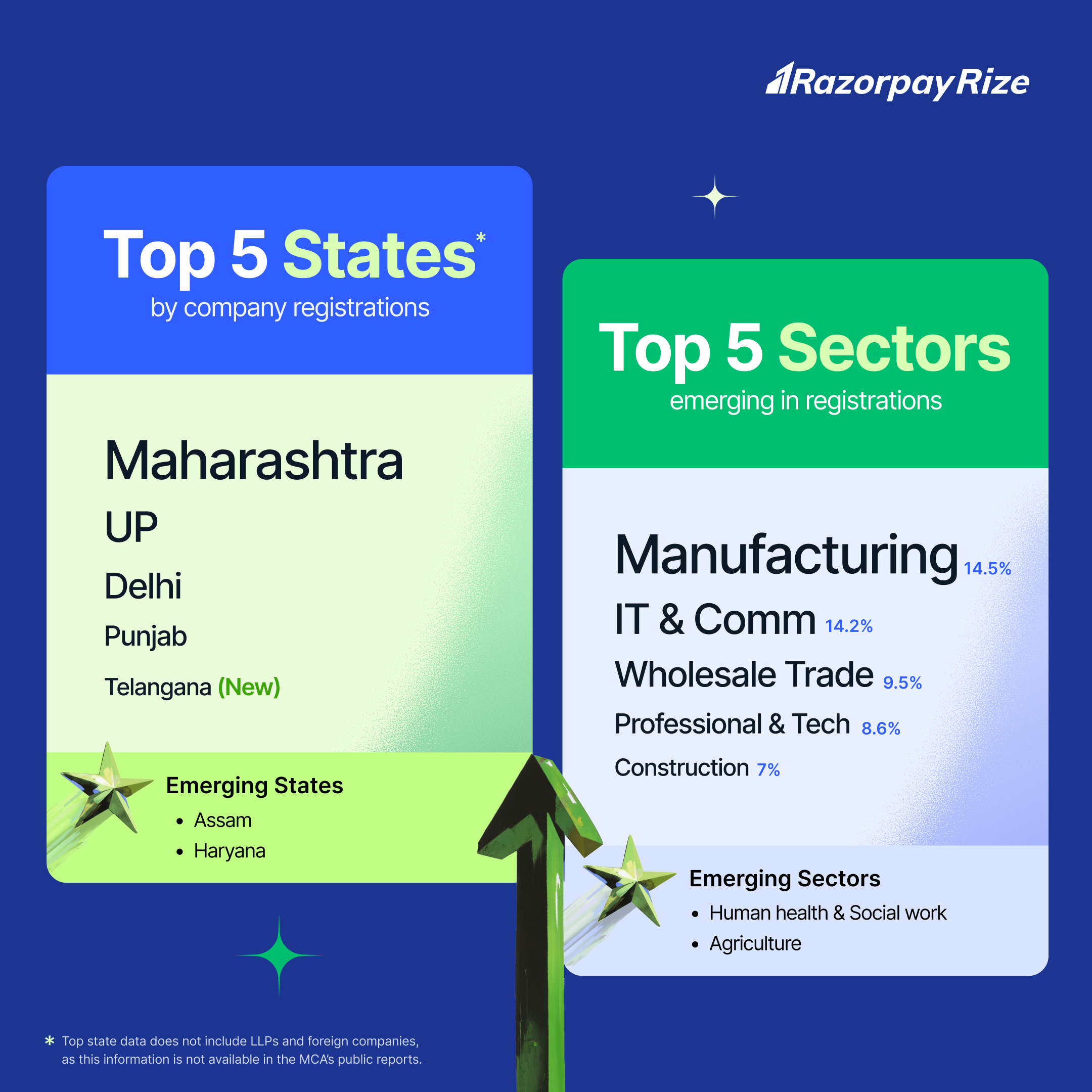
Top States & Sectors Leading Company Registrations

And behind every new registration, there’s a digital system quietly supporting this entrepreneurial momentum. Do you know what that digital platform is?

India’s journey to simplify entrepreneurship began long before these trends emerged. MCA21, the portal that founders rely on today for registering companies and managing post-registration compliances, was launched way back in 2006, making it one of the country’s first major e-governance initiatives. From facilitating registrations to supporting compliance, MCA21 has been at the heart of India’s growing startup ecosystem for nearly two decades.

Conclusion

As we close this August edition, one thing stands out: India’s startup ecosystem is buzzing with energy and constantly evolving. For founders and investors, these trends show where opportunities are cropping up. And, how every registration, every new idea, and every emerging sector is contributing to the larger story of a nation increasingly defined by its startups.

rize image

Register your Business at just 1,499 + Govt. Fee

Register your business
rize image

Register your Private Limited Company in just 1,499 + Govt. Fee

Register your business
rize image

Register your One Person Company in just 1,499 + Govt. Fee

Register your business
rize image

Register your Business starting at just 1,499 + Govt. Fee

Register your business
rize image

Register your Limited Liability Partnership in just 1,499 + Govt. Fee

Register your business

Private Limited Company
(Pvt. Ltd.)

1,499 + Govt. Fee
BEST SUITED FOR
  • Service-based businesses
  • Businesses looking to issue shares
  • Businesses seeking investment through equity-based funding


Limited Liability Partnership
(LLP)

1,499 + Govt. Fee
BEST SUITED FOR
  • Professional services 
  • Firms seeking any capital contribution from Partners
  • Firms sharing resources with limited liability 

One Person Company
(OPC)

1,499 + Govt. Fee
BEST SUITED FOR
  • Freelancers, Small-scale businesses
  • Businesses looking for minimal compliance
  • Businesses looking for single-ownership

Private Limited Company
(Pvt. Ltd.)

1,499 + Govt. Fee
BEST SUITED FOR
  • Service-based businesses
  • Businesses looking to issue shares
  • Businesses seeking investment through equity-based funding


One Person Company
(OPC)

1,499 + Govt. Fee
BEST SUITED FOR
  • Freelancers, Small-scale businesses
  • Businesses looking for minimal compliance
  • Businesses looking for single-ownership

Private Limited Company
(Pvt. Ltd.)

1,499 + Govt. Fee
BEST SUITED FOR
  • Service-based businesses
  • Businesses looking to issue shares
  • Businesses seeking investment through equity-based funding


Limited Liability Partnership
(LLP)

1,499 + Govt. Fee
BEST SUITED FOR
  • Professional services 
  • Firms seeking any capital contribution from Partners
  • Firms sharing resources with limited liability 

Frequently Asked Questions

Related Posts

What is a Patent? Types, Registration Process & Example Explained

What is a Patent? Types, Registration Process & Example Explained

In a world driven by innovation, protecting intellectual property is critical, not just for inventors but also for the advancement of science, technology, and industry as a whole. Patents are a powerful tool for safeguarding inventions, offering exclusive commercial rights, and encouraging investment in new ideas.

In this comprehensive guide, we’ll explore patents, the different types available, the filing process in India, what qualifies (and what doesn’t), and notable real-world examples.

Table of Contents

What is a Patent?

A patent is a legal right granted by a government authority to an inventor or assignee. It provides exclusive rights to make, use, sell, or license the invention for a fixed period, typically 20 years from the filing date (in the case of utility patents).

In India, patents are granted by the Indian Patent Office under the Indian Patent Act, 1970. Once granted, the patent gives the owner the legal authority to prevent others from commercially using the invention without consent.

In simple terms, a patent:

  • Protects original inventions
  • Offers a time-bound monopoly
  • Encourages innovation by offering a return on investment

Types of Patent

There are three main types of patents recognised globally (India primarily follows the utility patent framework):

1. Utility Patent

Covers new processes, machines, or compositions. These are the most common patents.
Example: A new smartphone battery technology.

Protection Duration: 20 years from the filing date.

2. Design Patent

Protects the unique visual appearance of an object, not its function.
Example: The contour design of a Coca-Cola bottle.

Protection Duration: 15 years (in countries where design patents are recognised separately).

3. Plant Patent

Covers new, asexually reproduced plant varieties.
Example: A genetically modified rose variety.

Protection Duration: 20 years (not commonly filed in India).

Related Read: Types of Patent 

Types of Patent Applications

In India, there are four primary types of patent applications, each serving a distinct purpose:

1. Provisional Application

A temporary application filed to secure a priority date while the invention is still being finalised. It is valid for 12 months (must file a complete specification within this period).

2. Complete Application

It contains the full invention description, claims, and drawings. Can be filed directly or after a provisional application. It's the final and examinable document.

3. Divisional Application

It is filed when a single application contains multiple inventions. It allows the applicant to split them into separate applications while retaining the same priority date.

4. Additional Application

It is filed for improvements or modifications of an already filed invention. It must be linked to the main patent and cannot stand alone.

Turn your innovative idea into a registered business. Start your company registration today and protect your intellectual property from day one.

Importance of a Patent

Patents are more than just legal documents; they are strategic assets for innovation-driven businesses. Here’s why they matter:

  • Protects Innovation: Prevents unauthorised use or duplication of your invention.
  • Drives Research: Encourages R&D by granting exclusivity.
  • Public Disclosure: Adds to the pool of technical knowledge through public databases.
  • Market Advantage: Offers a monopoly that helps recover R&D investments.
  • Licensing Revenue: Can be monetised via licensing deals or sales.
  • Investor Confidence: Adds credibility and attracts funding.
  • Eligibility for Government Support: Many startup schemes and grants favour IP-holding firms.

What Can Be a Patent?

Under Indian law, an invention is patentable if it meets the following criteria:

  • Novelty: It must be new and not disclosed anywhere else.
  • Inventive Step: It must involve technical advancement or economic significance.
  • Industrial Applicability: It should be capable of being made or used in an industry.

Patentable Categories:

  1. Processes (e.g., water purification method)
  2. Machines (e.g., robotic arms)
  3. Articles of Manufacture (e.g., ergonomic chairs)
  4. Compositions of Matter (e.g., pharmaceutical formulations)
  5. Improvements on existing inventions (e.g., a faster version of a known algorithm)

What Cannot Be Patented?

Under Sections 3 and 4 of the Indian Patent Act, certain inventions are not patentable, even if they are novel.

Key Exclusions:

  • Frivolous or contrary to natural laws (e.g., perpetual motion machine)
  • Scientific theories or mathematical methods
  • Methods of agriculture or horticulture
  • Traditional knowledge (e.g., turmeric for healing wounds)
  • Medical treatments or surgical methods
  • Business methods or algorithms
  • Mental acts or abstract ideas
  • Atomic energy-related inventions (under Section 4)

These exclusions maintain ethical, cultural, and practical boundaries in IP law.

Patent Examples

Here are a few real-world patent examples that transformed industries:

  1. Wright Brothers' Airplane (1906):
    The first powered aircraft patent. Paved the way for modern aviation.
  2. Apple’s Slide-to-Unlock (2009):
    A design feature that defined smartphone interaction.
  3. Pfizer’s Lipitor (1993):
    A cholesterol-lowering drug that became one of the best-selling medications.
  4. Dyson Vacuum Cleaner (1986):
    Innovative cyclone technology with no loss of suction.

How Much Does a Patent Cost in India?

The total cost of obtaining a patent in India varies based on complexity, legal support, and the size of the entity. The cost includes:

  • Government Fees
  • Professional Charges
  • Examination Request Fee
  • Additional Costs: Translation, drawings, office actions, renewals

Patent protection lasts for 20 years, subject to annual renewal fees after grant.

Content of a Patent

A patent document includes several structured sections that describe and define the invention:

  1. Title of the Invention
  2. Bibliographic Details (applicant name, filing date, etc.)
  3. Background / Prior Art
  4. Detailed Description (technical specifications and working)
  5. Drawings or Diagrams
  6. Claims 

Unlike academic writing, patent specifications are precise, technical, and legal in tone. Many researchers prepare their own drafts, but expert assistance ensures compliance with formal requirements and claim strength.

Procedure for Getting a Patent in India

Here’s a step-by-step overview of the Indian patent filing process:

  1. Document the Invention: Maintain detailed records, diagrams, and experimental data.
  2. Conduct a Patent Search: To check if similar inventions exist.
  3. Draft a Provisional or Complete Specification.
  4. File the Application at the Indian Patent Office (offline or online).
  5. Publication: The application is published after 18 months unless early publication is requested.
  6. Request for Examination (RFE): Must be filed within 48 months.
  7. Examination Report & Objections: Respond to objections and make amendments, if needed.
  8. Grant of Patent: If approved, the patent is granted and published in the journal.
  9. Renewals: Pay annual renewal fees to maintain validity.

Difference Between Patents vs. Trademarks vs. Copyrights

Feature Patent Trademark Copyright
What it Protects Inventions (process, device, product) Brand identifiers (logos, names, symbols) Original creative works (books, music, art, software)
Duration 20 years 10 years (renewable indefinitely) Lifetime + 60 years
Example New engine technology Nike swoosh logo A novel or film script

Frequently Asked Questions

rize image

Register your Business at just 1,499 + Govt. Fee

Register your business
rize image

Register your Private Limited Company in just 1,499 + Govt. Fee

Register your business
rize image

Register your One Person Company in just 1,499 + Govt. Fee

Register your business
rize image

Register your Business starting at just 1,499 + Govt. Fee

Register your business
rize image

Register your Limited Liability Partnership in just 1,499 + Govt. Fee

Register your business

Private Limited Company
(Pvt. Ltd.)

1,499 + Govt. Fee
BEST SUITED FOR
  • Service-based businesses
  • Businesses looking to issue shares
  • Businesses seeking investment through equity-based funding


Limited Liability Partnership
(LLP)

1,499 + Govt. Fee
BEST SUITED FOR
  • Professional services 
  • Firms seeking any capital contribution from Partners
  • Firms sharing resources with limited liability 

One Person Company
(OPC)

1,499 + Govt. Fee
BEST SUITED FOR
  • Freelancers, Small-scale businesses
  • Businesses looking for minimal compliance
  • Businesses looking for single-ownership

Private Limited Company
(Pvt. Ltd.)

1,499 + Govt. Fee
BEST SUITED FOR
  • Service-based businesses
  • Businesses looking to issue shares
  • Businesses seeking investment through equity-based funding


One Person Company
(OPC)

1,499 + Govt. Fee
BEST SUITED FOR
  • Freelancers, Small-scale businesses
  • Businesses looking for minimal compliance
  • Businesses looking for single-ownership

Private Limited Company
(Pvt. Ltd.)

1,499 + Govt. Fee
BEST SUITED FOR
  • Service-based businesses
  • Businesses looking to issue shares
  • Businesses seeking investment through equity-based funding


Limited Liability Partnership
(LLP)

1,499 + Govt. Fee
BEST SUITED FOR
  • Professional services 
  • Firms seeking any capital contribution from Partners
  • Firms sharing resources with limited liability 

Frequently Asked Questions

What do you mean by patent?

A patent is a legal right granted by a government to an inventor or assignee, giving them exclusive rights to make, use, sell, or license an invention for a limited period—typically 20 years from the date of filing. In exchange, the inventor must publicly disclose the details of the invention, contributing to scientific and technological knowledge.

What is a patent example?

Here are a few well-known examples of patented inventions:

  • Apple’s Slide-to-Unlock Feature (U.S. Patent No. 8,046,721): A widely recognised software patent that changed the way users interact with touchscreens.

  • Pfizer’s Patent for Lipitor (U.S. Patent No. 4,681,893): Protected the formula for a cholesterol-lowering drug that became a blockbuster medication.

Which Act governs the patent system in India?

The Indian patent system is governed by the Patents Act, 1970, along with the Patent Rules, 2003 (as amended). The Act defines what is patentable, outlines the procedure for filing and examination, and specifies the rights and obligations of patent holders.

The Controller General of Patents, Designs & Trade Marks (CGPDTM) oversees the administration and granting of patents through the Indian Patent Office.

Who can apply for a patent?

A patent application can be filed by:

  1. The true and first inventor (the person who actually created the invention)
  2. An assignee of the inventor (such as a company, research institution, or employer)
  3. A legal representative of a deceased inventor

In India, individuals, startups, small entities, educational institutions, and large companies can all apply for patents. Joint applications by multiple inventors or co-assignees are also permitted.

Swagatika Mohapatra

Swagatika Mohapatra is a storyteller & content strategist. She currently leads content and community at Razorpay Rize, a founder-first initiative that supports early-stage & growth-stage startups in India across tech, D2C, and global export categories.

Over the last 4+ years, she’s built a stronghold in content strategy, UX writing, and startup storytelling. At Rize, she’s the mind behind everything from founder playbooks and company registration explainers to deep-dive blogs on brand-building, metrics, and product-market fit.

Read more
Conversion of Private Limited Company to Public Limited Company: Step-by-Step Guide

Conversion of Private Limited Company to Public Limited Company: Step-by-Step Guide

For most growing businesses, starting out as a Private Limited Company (Pvt Ltd) feels like the natural choice- it offers the safety net of limited liability, manageable compliance requirements, and the flexibility to focus on building the business without too much red tape. But as the business scales, ambitions grow bigger. You might want to raise significant capital, bring in a larger investor base, or even dream of going public someday. That’s when converting into a Public Limited Company starts making real sense.

So, what changes when you move from private to public?

  • Access to Public Funds: Unlike a private company, a public limited company can tap into larger funding avenues through IPOs or private placements, opening doors to serious growth capital.

  • Ease of Share Transfer: In a public company, shares are freely transferable, making it easier for investors or shareholders to buy, sell, or exit, boosting liquidity and appeal.

  • No Member Cap: Private companies are capped at 200 shareholders, but public companies have no such limit, giving you the freedom to expand your ownership base.

In this guide, we’ll break down exactly what it takes to convert your private company into a public one under the Companies Act, 2013, and walk you through the compliance steps and practical things you need to be ready for once you’ve made the leap.

Table of Contents

Procedure for Conversion into a Public Limited Company

Converting a private limited company into a public limited company in India is governed by the Companies Act, 2013, and involves a formalised legal process. Here’s a step-by-step guide:

1. Convene a Board Meeting

2. Issue Notice for EGM

  • Send notices to all shareholders, directors, and auditors at least 21 days before the meeting.
  • The notice should include the agenda, draft resolutions, and explanatory statements.

3. Hold the Extraordinary General Meeting (EGM)

  • Pass a Special Resolution to approve the conversion from private to public.
  • Approve necessary alterations in the MoA (removal of “Private”) and AoA (removal of restrictive clauses on share transfer and member limits).

4. Filing with Registrar of Companies (RoC)

Submit the following forms with the Ministry of Corporate Affairs (MCA) portal:

  • MGT-14: Filing of special resolutions within 30 days of passing them.
  • INC-27: Application for conversion, along with certified copies of resolutions, amended MoA/AoA, and EGM minutes.

5. Scrutiny and Approval by RoC

The Registrar reviews the application and, upon satisfaction, issues a Fresh Certificate of Incorporation reflecting the change in company status from private to public.

Related Read: Private Company Vs Public Company: Key Differences Explained

Post-Conversion Requirements

Once the company has been converted into a public limited company, several post-conversion formalities must be completed to align with regulatory and operational standards:

1. Update Statutory Documents

  • Obtain a new PAN reflecting the updated company name.
  • Revise all statutory records, financial statements, and company stationery (letterheads, invoices, website, etc.).

2. Inform Bankers and Financial Institutions

  • Update your company’s status with existing banks and financial institutions.
  • Amend authorised signatories if required.

3. Intimate Regulatory Authorities

  • Notify relevant authorities such as tax departments, GST authorities, and regulatory bodies, if applicable.

4. Compliance with Public Company Norms

  • Increase the number of directors to a minimum of 3 (as required for a public company).
  • Appoint independent directors and comply with applicable listing regulations (if planning for a stock exchange listing).
  • Adhere to enhanced disclosure norms, audit requirements, and corporate governance standards.

5. Prepare for Capital Raising (Optional)

  • If planning an IPO, start preparing for SEBI compliance, drafting offer documents, and engaging with merchant bankers.

Frequently Asked Questions (FAQs)

rize image

Register your Business at just 1,499 + Govt. Fee

Register your business
rize image

Register your Private Limited Company in just 1,499 + Govt. Fee

Register your business
rize image

Register your One Person Company in just 1,499 + Govt. Fee

Register your business
rize image

Register your Business starting at just 1,499 + Govt. Fee

Register your business
rize image

Register your Limited Liability Partnership in just 1,499 + Govt. Fee

Register your business

Private Limited Company
(Pvt. Ltd.)

1,499 + Govt. Fee
BEST SUITED FOR
  • Service-based businesses
  • Businesses looking to issue shares
  • Businesses seeking investment through equity-based funding


Limited Liability Partnership
(LLP)

1,499 + Govt. Fee
BEST SUITED FOR
  • Professional services 
  • Firms seeking any capital contribution from Partners
  • Firms sharing resources with limited liability 
One Person Company
(OPC)

1,499 + Govt. Fee
BEST SUITED FOR
  • Freelancers, Small-scale businesses
  • Businesses looking for minimal compliance
  • Businesses looking for single-ownership

Private Limited Company
(Pvt. Ltd.)

1,499 + Govt. Fee
BEST SUITED FOR
  • Service-based businesses
  • Businesses looking to issue shares
  • Businesses seeking investment through equity-based funding


One Person Company
(OPC)

1,499 + Govt. Fee
BEST SUITED FOR
  • Freelancers, Small-scale businesses
  • Businesses looking for minimal compliance
  • Businesses looking for single-ownership

Private Limited Company
(Pvt. Ltd.)

1,499 + Govt. Fee
BEST SUITED FOR
  • Service-based businesses
  • Businesses looking to issue shares
  • Businesses seeking investment through equity-based funding


Limited Liability Partnership
(LLP)

1,499 + Govt. Fee
BEST SUITED FOR
  • Professional services 
  • Firms seeking any capital contribution from Partners
  • Firms sharing resources with limited liability 
Frequently Asked Questions

What Is the Form for Conversion of a Private Company into a Public Company?

The primary form used for the conversion of a private limited company into a public limited company in India is Form INC-27. It must be submitted along with supporting documents like the altered Memorandum of Association (MoA), Articles of Association (AoA), special resolution copy, and EGM minutes.Additionally, Form MGT-14 (for filing special resolutions) must also be filed within 30 days of passing the resolution at the EGM.

Can a Private Limited Company Go Public?

Yes, a Private Limited Company can go public by converting itself into a Public Limited Company.

After conversion, the company must comply with public company regulations under the Companies Act, 2013, including increased disclosure norms, appointment of independent directors (if applicable), and adherence to corporate governance standards.

What Section of the Companies Act, 2013 Governs Conversion of a Public Company into a Private Company?

The conversion of a Public Company into a Private Company is governed by Section 14 of the Companies Act, 2013.

  • Section 14(1) deals with altering the Articles of Association (AoA) to include provisions applicable to a private company.
  • Such a conversion requires passing a special resolution and obtaining approval from the Tribunal (NCLT) as mandated under Section 14(2).

Sarthak Goyal

Sarthak Goyal is a Chartered Accountant with 10+ years of experience in business process consulting, internal audits, risk management, and Virtual CFO services. He cleared his CA at 21, began his career in a PSU, and went on to establish a successful ₹8 Cr+ e-commerce venture.

He has since advised ₹200–1000 Cr+ companies on streamlining operations, setting up audit frameworks, and financial monitoring. A community builder for finance professionals and an amateur writer, Sarthak blends deep finance expertise with an entrepreneurial spirit and a passion for continuous learning.

Read more
Parent Company: Meaning, Types, & Examples

Parent Company: Meaning, Types, & Examples

In today’s global economy, many of the world’s most successful businesses don’t operate as standalone entities. Instead, they function as parent companies, overseeing a network of subsidiaries that contribute to growth, stability, and strategic expansion.

A parent company plays an important role in controlling, supporting, and directing its subsidiary companies, whether for financial, operational, or strategic purposes.

In this blog, we’ll define a parent company, explore different types, compare it with holding companies, and examine its benefits and real-world examples, such as Alphabet, Tata Group, etc.

Table of Contents

What is a Parent Company?

A parent company is a business entity that owns and controls one or more subsidiary companies. This control is usually achieved by holding a majority share (over 50%) in the subsidiary’s stock. While the parent company exercises influence over key decisions, strategy, and financial management, the subsidiaries often continue to operate independently with their own management teams.

The relationship enables the parent company to consolidate resources, reduce risks, and gain access to new markets while maintaining a diversified business structure.

Parent Company vs Holding Company

Though often used interchangeably, parent companies and holding companies serve different purposes and levels of operational involvement.

Aspect Parent Company Holding Company
Operational role Actively manages and supports subsidiaries Primarily owns shares, with minimal direct involvement
Subsidiary control Often involved in daily operations Rarely involved in daily operations
Examples Tata Group Tata Sons

Examples of Parent Companies

Here are a few notable examples of parent companies and the subsidiaries they control:

  • Alphabet Inc.
    • Subsidiaries: Google, YouTube, Waymo, DeepMind
    • Overview: Acts as the parent for Google's core businesses and experimental ventures.
  • Unilever
    • Subsidiaries: Dove, Axe, Lipton, Ben & Jerry’s
      Overview: Owns and manages a diverse portfolio of consumer goods brands globally

  • Tata Group (India)
    • Subsidiaries: Google, YouTube, Waymo, DeepMind
    • Overview: Acts as the parent for Google's core businesses and experimental ventures.

Register your company hassle-free with Razorpay Rize and get expert guidance every step of the way.

Types of Parent Company

Parent companies generally fall into two primary categories:

1. Holding Company

Key features of a holding company:

  • Owns majority shares in other companies.
  • Doesn’t directly engage in operations or sales.
  • Has control over its subsidiaries' major decisions.
  • Used for risk management, asset protection, and tax benefits.

Example: Tata Sons is the holding company of the Tata Group, which doesn't directly run these businesses but controls strategy and owns majority stakes.

2. Conglomerate

A conglomerate is a large business entity that owns and operates multiple companies across unrelated industries. Unlike a typical company that focuses on a single sector, a conglomerate diversifies its operations to spread risk, tap into different markets, and create multiple revenue streams.

Key Features of a Conglomerate:

  • Operates in diverse, unrelated sectors
  • Has a parent company that controls all subsidiaries
  • Subsidiaries often run independently, with strategic guidance from the parent company
  • Focuses on diversification, financial strength, and cross-industry synergies

Example: Tata Group operates in sectors from IT to steel to hospitality.

Benefits of the Parent Company

Establishing a parent company offers numerous strategic advantages:

  • Risk Diversification: Losses in one subsidiary don’t affect the entire business.
  • Financial Stability: Enables capital allocation and access to larger funding pools.
  • Tax Efficiency: Offers scope for tax optimisation across group entities.
  • Centralised Strategy: Unified direction and resource sharing improve efficiency.
  • Legal Protection: Limits liability and isolates financial risks.

These benefits make the parent-subsidiary model ideal for scaling operations across markets and industries.

How Do Parent Companies Work?

Parent companies function through a mix of ownership control and strategic management:

  • Ownership: Typically hold a majority stake in subsidiaries.
  • Oversight: Involved in major decisions, budgeting, reporting, and governance.
  • Independence: Subsidiaries retain autonomy for day-to-day operations.
  • Shared Services: Often provide HR, legal, and financial support to subsidiaries.

This model allows a parent company to guide subsidiaries while giving them room to innovate and grow.

{{company-reg-cta}}

How to Become a Parent Company

Becoming a parent company typically involves gaining control over one or more other companies. This can be achieved through various methods, each offering different advantages and challenges. The most common routes include acquisitions, creating subsidiaries, or forming joint ventures.

  1. Acquiring a Company: One of the fastest ways to become a parent company is by acquiring an existing business.
  2. Creating a Subsidiary: Another way is by setting up a subsidiary company—a separate legal entity that is wholly owned and controlled by the parent. This allows the parent company to:
    • Enter new markets
    • Launch new products
    • Manage specific risks or intellectual property independently
  3. Forming a Joint Venture: A joint venture involves two or more companies collaborating to create a new business entity, sharing ownership, control, and profits.

Conclusion

By holding majority stakes in subsidiaries, a parent company can effectively manage risk, diversify its investments, and expand its reach across different industries or regions. This structure allows parent companies to leverage resources, streamline operations, and enter new markets without starting from scratch.

From acquisitions and mergers to joint ventures and subsidiary creation, becoming a parent company opens doors to new growth opportunities and market dominance.

Frequently Asked Questions

rize image

Register your Business at just 1,499 + Govt. Fee

Register your business
rize image

Register your Private Limited Company in just 1,499 + Govt. Fee

Register your business
rize image

Register your One Person Company in just 1,499 + Govt. Fee

Register your business
rize image

Register your Business starting at just 1,499 + Govt. Fee

Register your business
rize image

Register your Limited Liability Partnership in just 1,499 + Govt. Fee

Register your business

Private Limited Company
(Pvt. Ltd.)

1,499 + Govt. Fee
BEST SUITED FOR
  • Service-based businesses
  • Businesses looking to issue shares
  • Businesses seeking investment through equity-based funding


Limited Liability Partnership
(LLP)

1,499 + Govt. Fee
BEST SUITED FOR
  • Professional services 
  • Firms seeking any capital contribution from Partners
  • Firms sharing resources with limited liability 
One Person Company
(OPC)

1,499 + Govt. Fee
BEST SUITED FOR
  • Freelancers, Small-scale businesses
  • Businesses looking for minimal compliance
  • Businesses looking for single-ownership

Private Limited Company
(Pvt. Ltd.)

1,499 + Govt. Fee
BEST SUITED FOR
  • Service-based businesses
  • Businesses looking to issue shares
  • Businesses seeking investment through equity-based funding


One Person Company
(OPC)

1,499 + Govt. Fee
BEST SUITED FOR
  • Freelancers, Small-scale businesses
  • Businesses looking for minimal compliance
  • Businesses looking for single-ownership

Private Limited Company
(Pvt. Ltd.)

1,499 + Govt. Fee
BEST SUITED FOR
  • Service-based businesses
  • Businesses looking to issue shares
  • Businesses seeking investment through equity-based funding


Limited Liability Partnership
(LLP)

1,499 + Govt. Fee
BEST SUITED FOR
  • Professional services 
  • Firms seeking any capital contribution from Partners
  • Firms sharing resources with limited liability 

Frequently Asked Questions

What is meant by the parent company?

A parent company is a business entity that owns and controls one or more subsidiary companies. It holds a majority stake in the subsidiary and has significant influence over the subsidiary's operations, decisions, and financial matters.

The parent company may also provide strategic direction, resources, and guidance, while the subsidiaries remain legally separate entities, often operating independently in their own markets or sectors.

How do I register a parent company?

To register a parent company, you’ll generally follow the same process as registering any company, with the added step of acquiring majority ownership in other companies or forming subsidiaries. Here’s a simplified process:

  • Choose the Business Structure: Decide if you want to set up a private limited company, a public limited company, or any other structure.
  • Obtain Necessary Approvals: If you plan on acquiring subsidiaries, ensure compliance with regulatory bodies (such as SEBI or RBI for foreign investments).
  • Register the Company: File the relevant documents with the Registrar of Companies and get the company incorporated.
  • Acquire Subsidiaries: Once your parent company is established, you can acquire controlling shares in other companies, making them your subsidiaries.

Depending on your business strategy, you may also establish a parent company by forming a joint venture, merger, or acquisition.

What qualifies as a parent company?

A parent company qualifies when it owns a majority stake (more than 50%) in one or more subsidiary companies. It must have the authority to control the operations and strategic decisions of the subsidiaries. The key characteristics of a parent company include:

  • Majority Ownership: Owns more than 50% of the voting shares in the subsidiary.
  • Control: Has the power to influence or direct the management and policies of the subsidiary.
  • Separate Legal Entity: While the parent company controls the subsidiary, both entities remain legally separate.

Is the parent company an owner?

Yes, a parent company is the owner of its subsidiaries. It owns a majority shareholding in the subsidiary companies, which gives it the authority to control its operations, direct its strategic goals, and influence its financial decisions.

While the subsidiaries operate as separate entities, the parent company effectively governs their overall direction, acting as the main stakeholder.

Nipun Jain

Nipun Jain is a seasoned startup leader with 13+ years of experience across zero-to-one journeys, leading enterprise sales, partnerships, and strategy at high-growth startups. He currently heads Razorpay Rize, where he's building India's most loved startup enablement program and launched Rize Incorporation to simplify company registration for founders.

Previously, he founded Natty Niños and scaled it before exiting in 2021, then led enterprise growth at Pickrr Technologies, contributing to its $200M acquisition by Shiprocket. A builder at heart, Nipun loves numbers, stories and simplifying complex processes.

Read more

Rize.Start

Hassle free company registration through Razorpay Rize

in just 1,499 + Govt. Fee
With ₹0 hidden charges

Make your business ready to scale. Become an incorporated company through Razorpay Rize.

Made with ❤️ for founders

View our wall of love

Smooth onboarding, seamless incorporation and a wonderful community. Thanks to the #razorpayrize team! #rizeincorporation
Dhaval Trivedi
Basanth Verma
shopeg.in
Exciting news! Incorporation of our company, FoxSell, with Razorpay Rize was extremely smooth and straightforward. We highly recommend them. Thank you Razorpay Rize for making it easy to set up our business in India.
@foxsellapp
#razorpayrize #rizeincorporation
Dhaval Trivedi
Prakhar Shrivastava
foxsell.app
We would recommend Razorpay Rize incorporation services to any founder without a second doubt. The process was beyond efficient and show's razorpay founder's commitment and vision to truly help entrepreneur's and early stage startups to get them incorporated with ease. If you wanna get incorporated, pick them. Thanks for the help Razorpay.

#entrepreneur #tbsmagazine #rize #razorpay #feedback
Dhaval Trivedi
TBS Magazine
Hey, Guys!
We just got incorporated yesterday.
Thanks to Rize team for all the Support.
It was a wonderful experience.
CHEERS 🥂
#entrepreneur #tbsmagazine #rize #razorpay #feedback
Dhaval Trivedi
Nayan Mishra
https://zillout.com/
Smooth onboarding, seamless incorporation and a wonderful community. Thanks to the #razorpayrize team! #rizeincorporation
Dhaval Trivedi
Basanth Verma
shopeg.in
Exciting news! Incorporation of our company, FoxSell, with Razorpay Rize was extremely smooth and straightforward. We highly recommend them. Thank you Razorpay Rize for making it easy to set up our business in India.
@foxsellapp
#razorpayrize #rizeincorporation
Dhaval Trivedi
Prakhar Shrivastava
foxsell.app
We would recommend Razorpay Rize incorporation services to any founder without a second doubt. The process was beyond efficient and show's razorpay founder's commitment and vision to truly help entrepreneur's and early stage startups to get them incorporated with ease. If you wanna get incorporated, pick them. Thanks for the help Razorpay.

#entrepreneur #tbsmagazine #rize #razorpay #feedback
Dhaval Trivedi
TBS Magazine
Hey, Guys!
We just got incorporated yesterday.
Thanks to Rize team for all the Support.
It was a wonderful experience.
CHEERS 🥂
#entrepreneur #tbsmagazine #rize #razorpay #feedback
Dhaval Trivedi
Nayan Mishra
https://zillout.com/